Showing posts with label Victualing. Show all posts

Regulations and Instructions for the Cook

"Cook" (Repro ID: PW5940) from the collections of the Royal Museums Greenwich - National Maritime Museum 

For the Cook.


Article one.
No person is to be rated as Cook who is not appointed by a warrant from the Commissioners of the Navy, to entitle him to which he must be a Pensioner of the Chest at Greenwich.
II.
The cook is to have a charge of the steep-tub, and the meat put into it, and he is to be held responsible for any part of it which shall be lost through his want of care.
III.
He is to see that the steep-tub is at all times well secured, and he is to be particular in examining it when there is an appearance of blowing weather; but if, notwithstanding his attention, it should be washed away, or lost by any accident which he could not prevent, he is to obtain from the Captain a certificate of the manner in which it was lost, and is to make oath to the number of pieces of meat that were lost in it, but they may be allowed to the Purser in his accounts.
IV.
He is to see that the salt meat properly watered, and that all provisions are very carefully and cleanly boiled; and that they are served out to the men according to the established practice of the Navy.
V.
When fresh meat is served, he is to be attentive and seeing the greens, and all other vegetables that are to be boiled with it, very carefully washed before they are put into the coppers; and when he serves on soup or burgou, he is strictly charged to do it without any partiality, giving to every man, as nearly as possible, in equal quantity.
VI.
He is not, on any account, to give the skimmings of the coppers in which salt meat has been boiled to the men, either to mix with their puddings, or to use in any other manner, as scarcely any thing more unwholesome, or more likely to produce the scurvy, can be eaten.
VII.
He is to clean the Coppers as soon as possible after the provisions are taken out of them; and he is to examine them very carefully every morning before any provisions are put into them, and to inform the Mate of the watch when he has done so, who is himself to examine them, and report their condition to Lieutenant of the watch.
VIII.

He is to be very careful of the fuel, never using more than is really necessary under the coppers, nor allowing more fire than is wanted to be made in the range.

Our Daily Bread -- Feeding the Fleet

There shall be allowed to every person serving in his majesty ships, a daily proportion of provisions, as expressed in the following table,

Together with an allowance of Vinegar, not to exceed have a pint to each man per week.

In case it should be found necessary to alter any of the foregoing particulars of provisions, and to issue other species as their Substitutes, it is to be observed,

That a pint of Wine, or have a pint of Rum, Brandy, or other Spirits, holds proportion to a gallon of Beer.

At 4 pounds of Flour, or 3 pounds thereof with 1 pound of Raisins, are equal to 4 pound pieces of Salt Beef.

They have a pint of Currents, or ½ lb. of Beef suet is equal to 1 pound of Raisins.

The 4 pounds of fresh Beef, or 3 pounds of Mutton, are equal to 4 pounds of salt Beef, and 3 pounds of fresh Beef, or Mutton, to a 2 pound piece of salt Pork, with pease.

That whenever Rice is issued either for Bread, Pease, Oatmeal or Cheese, 1 pound of Rice is to be considered equal to a pound of Bread, a pint of pease, a quart of Oatmeal, or a pound of Cheese.

That a pint of Wheat, or Pot of Barley, is equal to a pint of Oatmeal;

At 5 pounds and 3/4 Molasses are equal to 1 gallon of Oatmeal;

Then when Sugar is substituted for Butter or Cheese, 1 pound of Sugar is equal to 1 pound of Butter, or 2 pounds of Cheese.

That 1 pound of Oil is equal to a pound of Butter, or 2 pounds of Cheese; and that ½ lb. of Cocoa, or 1/4 pound of Tea, is equal to 1 pound of Cheese.

The Pipe to Dinner and the Noon Ration of GROG


"Pipe to dinner"

These words, followed by a glorious burst of shrill sounds, "long drawn out," are hailed with a murmur of delight by many a hungry tar and jolly marine.  The merry notes are nearly drowned next instant in  the rattle of tubs and kettles, the voice of the ship's cook and his mates calling out the numbers of the messes, the sound of  feet trampling along the decks and down the ladders, with the ample store of steaming provisions; such a set up and braces seaman's frame and give it vigour for any amount of physical action.

Then comes the joyous grog!  That nautical nectar, so dear to the lips of every blue-jacket, with which he washes down his Majesty's junk, as he roughly, but good humouredly styles the government allowance of beef; and while he quaffs off his portion, or his whack, as he calls it, he envies no man alive, and laughs to scorn those party philanthropists who describe his life as one of unhappy servitude.

Up to the year 1824 every man on board was allowed, each day, no less a quantity and half-a-pint of ardent spirits, mixed with three half-pints of water; but, even when thus diluted, the allowance formed a quart of extremely strong drink.  It was divided into two portions, one-half being served out soon after noon, the other between four and five o'clock.  This quantity was undoubtedly a great deal more than the average strength of a man's head could bear; and, in the opinion of the most observant officers in the navy, a large portion of all punishments were consequent upon offenses caused by the inebriating effect. The captain was not allowed to diminish the allowance, while among the man it would've been a reproach and anyone not to have drunk the whole, whatever his own taste might be.

Ship's Biscuit


William Falconer’s A New Universal Dictonary of Marine, ca. 1815 explains victualling-office’s process of manufacturing sea biscuits:

BISCUIT, Sea, is a sort of bread much dried, to make it keep for the use of the navy, and is good for a whole year after it is baked.
The process of biscuit-making for the navy is simple and ingenious, and is nearly as follows: A large lump of dough, consisting merely of flower and water, is mixed up together, and placed exactly in the centre of a raised platform, where a man sits upon a machine, called a horse, and literally rides up and down throughout its whole circular direction, till the dough is equally indented, and this is repeated till the dough is sufficiently kneaded.
In this state it is handed over to a second workman, who, with a large knife, puts it in a proper state for the use of those bakers who more immediately attend the oven. They are five in number; and their different departments are well calculated for expedition and exactness.
The first man on the farthest side of a large table moulds the dough, till it has the appearance of muffins, and which he does two together, with each hand; and then delivers them over to the man on the other side of the table, who stamps them on both sides with
a mark, and throws them on a smaller table, where stands the third workman, whose business is merely to separate the different pieces into two, and place them under the hand of him who supplies the oven, whose work of throwing or chucking the biscuits on the peel must be performed with the greatest exactness and regularity. The fifth arranges them in the oven, and is so expert, that though the different biscuits are thrown to him at the rate of seventy in a minute, the peel is always disengaged in time to receive them separately.
So much critical exactness and neat activity occur in the exercise of this layout, that it is difficult to decide whether the palm of excellence is due to the moulder, the maker, the splitter, the chucker, or the depositor; all of them, like the wheels of a machine, seeming to be actuated by the same principle. The business is to deposit in the oven seventy biscuits in a minute; and this is accomplished with the regularity of a clock; the clack of the peel, during its motion in the oven, operating like the pendulum. The biscuits thus baked are kept in repositories, which receive warmth from being placed in drying lofts over the ovens, till they are sufficiently dry to be packed into bags, without danger of getting mouldy; and when in such a state, they are then packed into bags,of an hundred weight each, and removed into store-houses for immediate use.

At Deptford the bake house belonging to the victualling-office has twelve ovens; each of which bakes twenty shoots daily; the quantity of flour used for each shoot is two bushels, or 112 pounds; which baked, produce 102 pounds of biscuit. Ten pounds are regularly allowed on each shoot for shrinkage, &c. The allowance of biscuit in the navy is, one pound for each man per day; so that, at Deptford alone, they can furnish bread, daily, for 24,480 men, independent of Portsmouth and Plymouth.


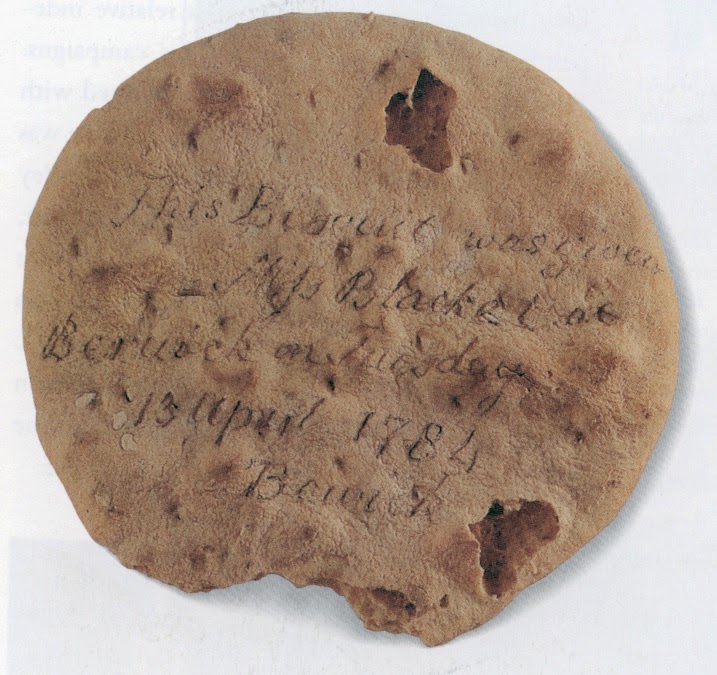
The ship’s  biscuit above was given as a souvenir to a Miss Blacket of Berwick in 1784 now in possession of the National Maritime Museum - Greenwich.